

New Irrigation System Installation for Residential & Commercial Properties
A well-designed irrigation system doesn’t just keep your lawn green — it protects your landscaping investment, reduces water waste, and adds real value to your property. Whether you’re building new construction, replacing an outdated system, or adding irrigation to a property that’s never had it, Genesis 7 designs and installs systems built to last.
Every installation is performed by a TCEQ Licensed Irrigator, engineered to code, and backed by a written warranty. We handle everything from the initial design through the final walk-through — including permits.
Is a New System Right for You?
A new installation may be the right call if:
- Your property has never had an irrigation system installed
- You’re in new construction and need a system designed from the ground up
- Your existing system is outdated, undersized, or beyond reliable repair
- You’ve purchased a property with no irrigation records or as-built plans
- You’re expanding your landscaping and your current system can’t cover the new area
- You’re a property manager or developer installing irrigation across multiple units or zones
Not sure whether repair or replacement makes more sense for your situation? We offer system inspections that give you an honest assessment — no upsell, just a straight answer.
What Every Genesis 7 Installation Includes
Texas law sets minimum standards for every new irrigation installation under 30 TAC Chapter 344, and we meet all of them. Here’s what’s included in every job:
Site assessment and pressure testing Before a single line is drawn, we measure the flow rate and static pressure at your water source. Zone count and system design can’t be accurately determined without this step — anyone who skips it is guessing.
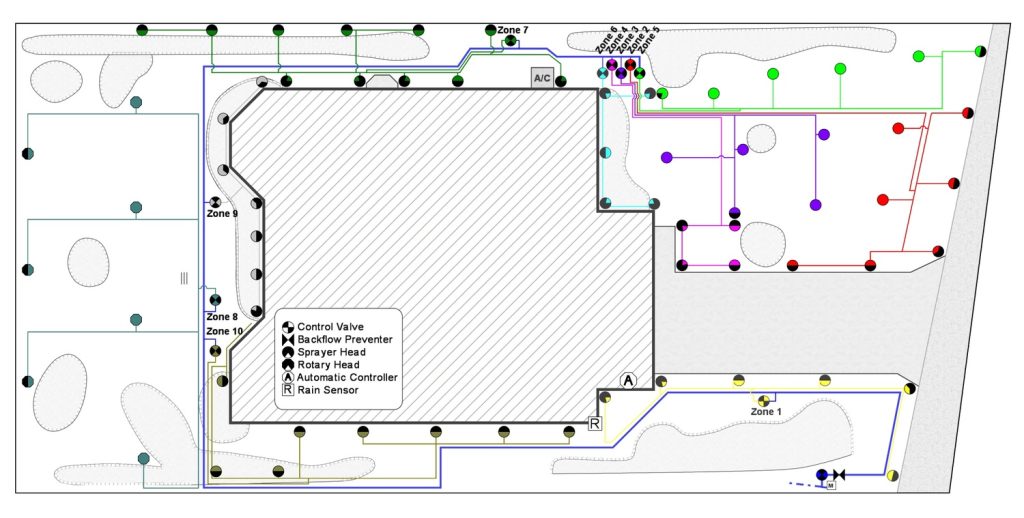
Custom irrigation plan, drawn to scale Every new installation requires a professionally drawn irrigation plan bearing the licensed irrigator’s seal, signature, and date. The plan documents all zones, emission devices, valve locations, backflow prevention device placement, controller and sensor locations, and design pressure. A copy stays on-site during installation, and you receive the final as-built drawing when the job is complete.
Zoning for plant type and microclimate Texas rules require that zones be separated by plant type (turf, shrubs, trees) and microclimate (sun vs. shade exposure, topography, soil type). A properly zoned system doesn’t overwater your shaded beds while your sunny lawn dries out — it applies the right amount of water to the right areas.
Backflow prevention device Required on every system. The backflow preventer stops irrigation water — along with any fertilizers, pesticides, or soil contaminants it may carry — from flowing backward into your potable water supply. It’s not optional under Texas law, and it must be installed in compliance with TCEQ and applicable local plumbing codes.
Rain and freeze sensor Texas requires a rain or freeze sensor (or equivalent technology) on every new irrigation system. This device automatically interrupts scheduled irrigation during rainfall or freezing conditions — protecting both your landscaping and your water bill.
Controller installation and programming We install and program your irrigation controller with an initial watering schedule calibrated to your plant types, zone layout, and local watering restrictions. You receive the controller’s owner’s manual and a written suggested watering schedule to reference going forward.
Final walk-through When the installation is complete, we walk through the entire system with you or your designated representative — zone by zone. You’ll see every head, every valve, and every sensor, and we’ll explain how to operate and adjust the controller. This walk-through is required by Texas law and documented in writing.
Written warranty Texas law requires a written warranty on all new irrigation installations. You receive a copy, and we keep one on file. The warranty must be signed by you or your representative confirming receipt — we won’t consider the job closed until that’s done.
The Permitting Process in Texas
New irrigation installations in Texas involve two layers of requirements: state standards set by TCEQ and local permit requirements set by your city or water district. Genesis 7 handles both.
State requirements (TCEQ / 30 TAC Chapter 344) These apply to every new irrigation installation in Texas, regardless of where you live. They govern system design standards, required components, documentation, and what you must receive upon completion. All Genesis 7 installations are designed and documented to meet these standards.
Local permits Many Texas municipalities — particularly cities with populations over 20,000 — are required by state law (HB 1656) to adopt local irrigation ordinances and require permits before work begins. In cities that require permits:
- The sealed irrigation plan must be submitted for review and approval before installation starts
- The licensed irrigator (or their company) must be registered with the city
- Work cannot begin until the permit is issued
- After installation, the backflow prevention device must be tested by a certified backflow tester and the test results submitted to the city
- A final inspection may be required before the system is placed into service
In rural areas and unincorporated counties — which describes much of Genesis 7’s service area in Southeast Texas — local permit requirements vary or may not apply. We research the specific requirements for your address before work begins so there are no surprises.
What Genesis 7 does: We pull the permit, submit the sealed plans, coordinate backflow testing, and schedule any required inspections. You don’t have to navigate city offices or figure out what’s required in your jurisdiction — that’s our job.
What You Receive When the Job Is Complete
At the conclusion of every new installation, Texas law requires that you receive all of the following. We provide every item — in writing, not verbally:
- As-built irrigation plan — a drawing of the system as actually installed, including any variances from the original design, signed and sealed by the licensed irrigator
- Written warranty — covering the installation, with start and end dates clearly stated
- Controller owner’s manual
- Written watering schedule — a suggested schedule appropriate for your zones and plant types
- Maintenance checklist — what to check and when to keep the system running efficiently
- Copy of permit and inspection documentation (where applicable)
Keep these documents. If you sell your property, buyers and their agents will ask for them. If you ever need service or repairs, having the as-built plan means a technician can work from a map of your system rather than starting from scratch.
Residential Installations
For homeowners, a new irrigation system should be sized right from the start — not oversized to sell more zones, and not undersized to cut the initial cost. We design residential systems based on your actual yard dimensions, soil type, sun and shade exposure, plant types, and water pressure available at the meter.
Common residential installation scenarios:
- New home with no existing irrigation
- Replacement of an old system with incorrect zoning or outdated components
- Expansion of an existing system to cover a new addition, garden, or landscaped area
- Installation on a property served by a private well (we’re licensed for well-connected systems in unincorporated areas)
We work with all major manufacturers including Hunter and Rain Bird and can install conventional spray systems, rotor systems, drip irrigation, or a combination — whatever your landscape actually calls for.
Commercial Installations
For commercial properties, irrigation is a facilities and liability issue as much as an aesthetic one. An improperly designed or unlicensed installation creates compliance exposure, ongoing maintenance costs, and can result in fines if the work doesn’t meet TCEQ or local code standards.
Genesis 7 installs commercial irrigation systems for:
- Property management companies and apartment complexes
- HOA common areas, entrances, and green spaces
- Retail centers and office parks
- Industrial and warehouse facilities with perimeter or grounds irrigation
- Municipalities, school campuses, and public facilities
- Developers and builders — new construction coordination available
For commercial clients, we provide all required documentation for your records, coordinate with general contractors or property managers as needed, and can design multi-zone systems with smart controllers capable of remote monitoring and scheduling.
Why Genesis 7
Licensed by the state of Texas — TCEQ License LI #0023338. Required for every installation, by law.
Fully documented — sealed plans, as-built drawings, warranty, permit records. No corners cut on paperwork.
Permits handled — we research local requirements for your address and pull the permit. You don’t have to.
Free estimates — we’ll assess your property, measure your water pressure, and give you a written estimate before any commitment is made.
No trip charge — coming out to look at your property doesn’t cost you anything.
Bilingual — English and Spanish, born and raised in Texas.
Serving Southeast Texas since 2017 — based in Woodville, TX, covering Tyler, Hardin, Jasper, Polk, Newton, Sabine, San Augustine, Angelina, Orange, and Jefferson counties. See our service area map
Ready to get started?
Common Questions About New Installations
How long does it take to install a new irrigation system? Most residential installations are completed in two to three days. Commercial systems vary depending on size, zone count, and site conditions. We’ll give you a realistic timeline with your estimate.
Do I need to be home during the installation? You don’t need to be present for the work itself, but we do require you or your representative to be available for the final walk-through when the job is complete.
Can you install on a property served by a well? Yes. Genesis 7 is licensed to connect irrigation systems to water wells in unincorporated areas of Texas, in addition to public and private water supplies.
What if I already have a partial system? We can evaluate what’s in place, determine whether it meets current TCEQ standards, and either incorporate it into a new design or replace components as needed. An inspection is the right starting point.
Do you install drip irrigation? Yes. Drip and micro-spray systems are appropriate for certain plant beds, narrow planting areas, and water-conservation applications. We’ll recommend the right emission type for each zone based on what you’re growing and where.
What happens if I hire someone without a license to install my system? Under Texas Occupations Code §1903.251, unlicensed irrigation installation is a Class C misdemeanor with civil penalties up to $5,000 per day. Beyond the legal risk, an unlicensed installation has no warranty protections, may not meet TCEQ design standards, and creates liability exposure for commercial property owners operating under compliance requirements.